
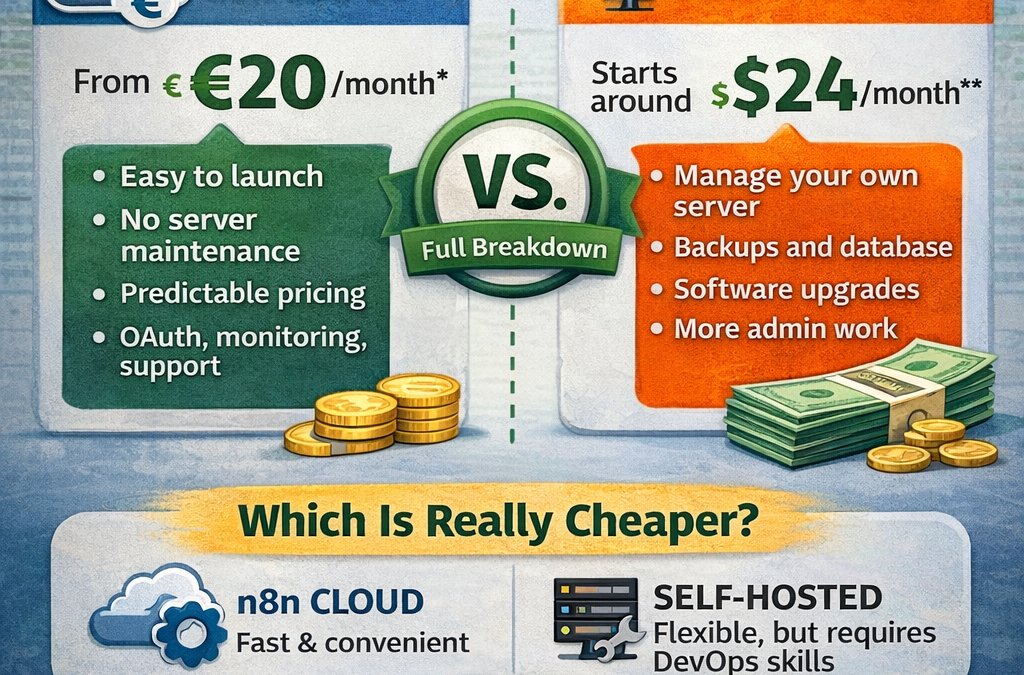
n8n Cloud vs Self-Hosted: Full Cost Breakdown
If you are planning to use n8n seriously, one of the biggest questions is simple: should you choose n8n Cloud or self-host n8n yourself? The answer is not just about monthly price. It is about time, maintenance, scaling, security, flexibility, and the real hidden cost of running automations in production.
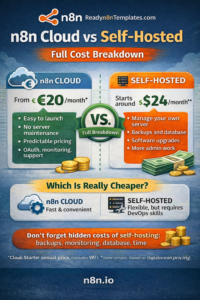
n8n Cloud vs self-hosted
For readers of Readyn8nTemplates.com, this is one of the most important decisions to understand before building client workflows, internal automations, or AI-powered systems. At first glance, self-hosting can look cheaper. But once you include infrastructure, backups, updates, database costs, uptime risk, and your own time, the picture changes fast. n8n’s official pricing currently starts at €20/month for Cloud Starter, €50/month for Cloud Pro, and €667/month for the self-hosted Business plan, while the Community edition remains free to self-host without a paid license.
What n8n Cloud includes
n8n Cloud is the hosted version managed by n8n. The biggest advantage is convenience. n8n handles hosting, upgrades, monitoring, and much of the operational side for you. n8n also highlights benefits like no technical setup or maintenance, one-click OAuth connections, one-click upgrades, uptime monitoring, and team collaboration.
As of April 15, 2026, the official pricing page shows:
Starter: €20/month billed annually with 2,500 workflow executions, 1 shared project, and 5 concurrent executions.
Pro: €50/month billed annually with a custom execution tier, 3 shared projects, 20 concurrent executions, admin roles, workflow history, execution search, and global variables. The help center notes Pro execution tiers such as 10k and 50k.
Enterprise: custom pricing, available hosted by n8n or self-hosted, with advanced governance and support features.
Cloud pricing is based on workflow executions, not steps. That is a major difference from many automation platforms. A short workflow and a very complex one both count as one execution when they run end-to-end.
What self-hosted n8n includes
If you self-host n8n, you can run the Community edition without paying a license fee, because n8n offers a free self-hosted option. But “free” only applies to the software license. You still have to pay for infrastructure and manage the system yourself.
The official docs are very clear that self-hosting requires technical knowledge, including:
setting up servers and containers
managing resources and scaling
securing the server and application
configuring n8n properly
n8n even recommends Cloud for people who are not experienced at managing servers, because mistakes in self-hosting can lead to downtime, data loss, or security issues.
That means the self-hosted option is best for developers, technical founders, agencies with DevOps skills, and teams that specifically need more control over their environment.
The official price gap most people miss
A lot of people compare Cloud Starter at €20/month to Community self-hosted at $0 license cost and assume self-hosting wins. That comparison is incomplete. The real comparison is:
Cloud: software + hosting + maintenance bundled together
Self-hosted: software license may be free, but hosting, database, backups, storage, updates, and operational effort are on you
There is another important pricing detail: the official Business plan is currently self-hosted only and priced at €667/month billed annually for 40,000 workflow executions, with features like SSO, environments, scaling options, and Git-based version control.
So when people say “self-hosting is always cheaper,” that is only true for the Community edition and only when you ignore your infrastructure and admin costs.
Self-hosted cost breakdown: the real components
Here is where self-hosting becomes more realistic.
1. Server or VPS cost
You need a server to run n8n. On DigitalOcean, Droplet pricing currently starts at $4/month. That is only the starting point, not a guarantee that it is ideal for your production workload.
2. Backups
If you enable Droplet backups on DigitalOcean, the price is 20% of Droplet cost for weekly backups or 30% for daily backups.
3. Database
You can run PostgreSQL yourself on the same server, but many users prefer a managed database for reliability. DigitalOcean’s managed PostgreSQL pricing currently starts at $15.15/month.
4. File storage / binary data storage
If your workflows store files, exports, images, or backups, you may want object storage. DigitalOcean Spaces currently starts at $5/month.
5. Maintenance time
This is the hidden cost most people ignore. Self-hosting means you are responsible for:
updates
testing upgrades
watching for breaking changes
SSL and security
monitoring
recovery if the server crashes
The official n8n docs recommend updating self-hosted n8n regularly and checking release notes for breaking changes.
Example self-hosted cost scenarios
Here is a simple way to think about the numbers.
Budget lab setup
A very basic self-hosted test setup could be just:
VPS: $4/month
no managed database
no object storage
minimal protection and no serious redundancy
That makes the entry price look very low. But this is closer to a test or hobby setup than a production-safe business environment. The official docs stress that self-hosting needs technical care and that Cloud is recommended for less experienced users.
More realistic small production setup
A more practical small setup could look like:
Droplet: from $4/month
daily backups: about 30% extra on the Droplet
managed PostgreSQL: from $15.15/month
Spaces object storage: $5/month
Using those official starting prices, you are already around $24 to $25+ per month before counting your time, and that is still a very lean setup.
In other words, self-hosted Community edition is not really “free.” It is often “cheap at the start, then gradually more expensive as your reliability requirements grow.”
When n8n Cloud is the better deal
n8n Cloud is often the better choice when:
you want to launch quickly
you do not want server maintenance
you are a solo founder or small team
you want predictable pricing
you care more about speed than infrastructure control
For many users, €20/month or €50/month is easier to justify than paying for a VPS, backups, storage, database, and your own admin time. Cloud also gives you OAuth convenience, hosted uptime monitoring, and managed upgrades.
This is especially true for agencies, creators, and small businesses that want to build automations instead of managing infrastructure.
When self-hosted is the better deal
Self-hosted n8n can still be the smarter option when:
you need full control over your environment
you want custom domains or deeper infrastructure control
you need settings that Cloud does not expose
you have internal DevOps skills
you want to keep data on your own infrastructure
The n8n help center notes that Cloud plans do not let you set custom environment variables, custom base URLs or domains, custom ports, proxies, or custom TLS/SSL settings. Those are self-hosted advantages.
So if flexibility matters more than convenience, self-hosting can absolutely be worth it.
Hidden cost: your own time
The biggest cost difference is not always the invoice. It is the time cost.
With Cloud, most of your time goes into building workflows.
With self-hosted, some of your time shifts into:
installing
configuring
troubleshooting
updating
securing
recovering from issues
If you are billing your time, that labor can easily cost more than the monthly subscription difference. That is why many businesses discover that Cloud is actually cheaper in practice, even if the sticker price looks higher at first.
Final verdict
So, n8n Cloud vs self-hosted: which is cheaper?
The honest answer is:
Cloud is usually cheaper in total effort for solo users, startups, and teams that want simplicity.
Self-hosted can be cheaper in license cost, but only if you are comfortable handling infrastructure and accepting the maintenance burden.
Self-hosted becomes more attractive when control, customization, and data ownership matter more than convenience.